
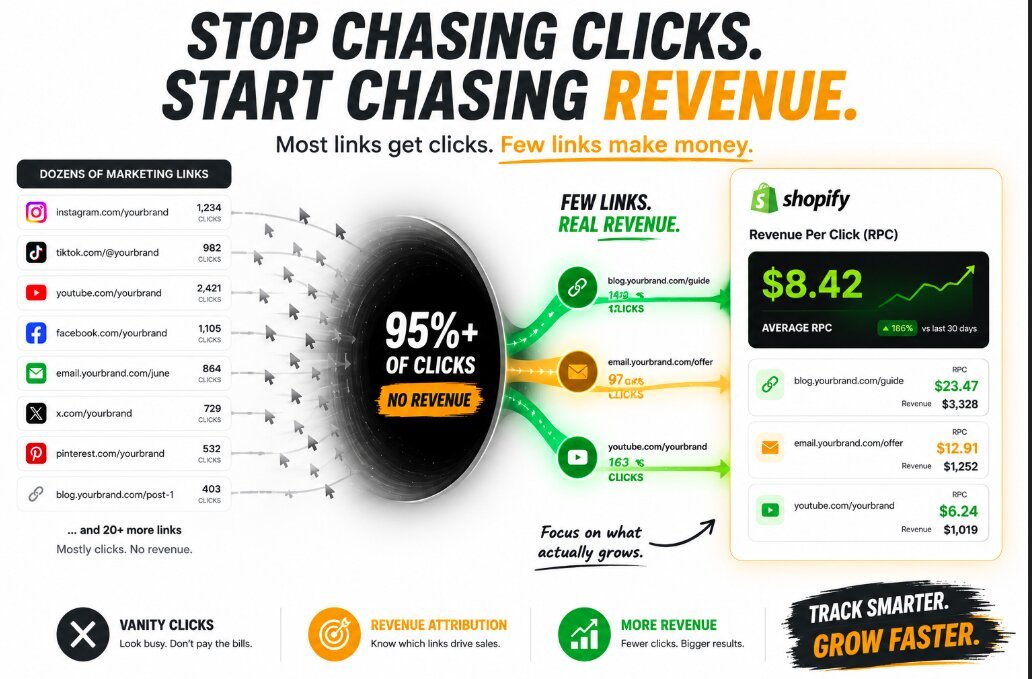
Most Shopify store owners think attribution is already solved.
After all, Shopify shows revenue, orders, sessions, and marketing channels. You can see sales coming in and watch your dashboard update in real time.
But there's a critical question most stores still can't answer:
Which specific link generated the sale?
That's where Shopify link tracking becomes important.
Knowing a sale came from Instagram, email, or Facebook is useful. Knowing the exact creator link, newsletter placement, ad variation, or landing page that generated the purchase is what actually helps you make better decisions.
The difference between those two levels of visibility is often the difference between scaling profitably and wasting budget.
Shopify Shows Orders. It Doesn't Show What Actually Drove Them.
Shopify gives store owners plenty of data.
You can easily see:
- Revenue
- Orders
- Sessions
- Conversion rates
- Marketing channels
At first glance, that sounds like enough.
The problem is that most growth decisions happen below the channel level.
For example:
- Which creator generated the highest-value customers?
- Which Instagram bio link produced actual sales?
- Which newsletter link converted best?
- Which affiliate partner deserves a larger commission?
- Which ad variation attracted buyers instead of browsers?
Many stores can't answer those questions with confidence.
Instead, they rely on broad channel reporting.
The result is a dangerous blind spot.
The Attribution Blind Spot
Most attribution systems stop at categories.
They tell you:
- Facebook generated revenue.
- Email generated revenue.
- Organic search generated revenue.
That's helpful.
But Facebook isn't a strategy.
Email isn't a strategy.
Those are containers.
Inside every channel are dozens—or hundreds—of individual assets competing for attention and driving different outcomes.
When attribution stops at the channel level, profitable opportunities stay hidden.
At the same time, underperforming campaigns continue receiving budget because they happen to sit inside a channel that appears successful.
This is one of the biggest weaknesses in modern ecommerce attribution.
The Missing Piece in Shopify Revenue Attribution
The real opportunity starts when you move beyond channels and begin tracking links.
Consider a typical Facebook campaign.
Inside that campaign you might have:
- 10 ads
- 20 creative variations
- Multiple audiences
- Several landing pages
- 50+ destination URLs
Shopify may tell you Facebook generated $20,000 in revenue.
But which link generated it?
That's the question that matters.
Without link-level visibility, optimization becomes guesswork.
You end up making decisions based on averages instead of performance.
Why Channel Attribution Isn't Enough
Imagine two links inside the same campaign.
Link A
- 500 clicks
- $50 revenue
Link B
- 100 clicks
- $1,200 revenue
Most reporting systems immediately draw attention to Link A because it generated more traffic.
More clicks feel like success.
But Link B generated 24 times more revenue.
If you're optimizing for traffic volume, you'll invest in the wrong asset.
If you're optimizing for revenue, the answer is obvious.
This is why Shopify revenue attribution needs to go beyond channels and into individual links.
Revenue Per Click Reveals What Actually Matters
The most useful metric for evaluating traffic quality isn't CTR.
It's Revenue Per Click (RPC).
Revenue Per Click answers a simple question:
How much revenue does each click generate?
Formula:
RPC = Revenue ÷ Clicks
Using the previous example:
Link A:
- $50 revenue
- 500 clicks
- RPC = $0.10
Link B:
- $1,200 revenue
- 100 clicks
- RPC = $12.00
The difference is dramatic.
One click from Link B is worth 120 clicks from Link A.
That's the type of insight traditional analytics often miss.
RPC shifts focus away from popularity and toward profitability.
How to Track Revenue Back to Individual Links
Better attribution starts with better tracking.
The goal isn't collecting more data.
The goal is connecting revenue to the exact source that produced it.
Track Every Marketing Link Separately
One of the most common attribution mistakes is grouping too much traffic together.
Many stores send multiple campaigns through the same destination URL and then wonder why reporting becomes unclear.
Every important traffic source should have its own tracking identifier.
This includes:
- Email links
- Influencer links
- Creator partnerships
- Bio links
- Affiliate links
- Paid ad destination URLs
- QR codes
- SMS campaign links
When every link is tracked independently, attribution becomes far more precise.
Instead of seeing "Instagram revenue," you can see which creator, post, story, or bio link generated sales.
That's a completely different level of insight.
Connect Click Data to Shopify Orders
Click tracking alone doesn't solve attribution.
This is where many traditional link shorteners fall short.
Tools like Bitly can tell you:
- How many clicks occurred
- Where traffic came from
- Device information
Useful data.
Incomplete data.
A click is only the beginning of the customer journey.
The real objective is:
Click → Session → Purchase → Revenue
If your tracking stops after the click, you're missing the outcome that matters most.
This is why effective Shopify campaign tracking requires connecting click activity directly to store revenue.
Once those systems work together, every link becomes measurable in financial terms.
Measure Revenue Per Click
After revenue is connected to individual links, RPC becomes one of the most valuable metrics in your reporting stack.
The calculation remains simple:
Revenue Per Click = Revenue ÷ Clicks
But the decisions it enables are powerful.
Instead of asking:
"Which campaign got the most traffic?"
You start asking:
"Which campaign generated the most revenue per visitor?"
Those questions produce very different answers.
And much better budget allocation.
Find Hidden Winners
One of the most surprising outcomes of link-level attribution is discovering opportunities hiding in plain sight.
Many ecommerce brands assume bigger audiences always perform better.
The data often says otherwise.
For example:
A creator with 500,000 followers generates:
- 10,000 clicks
- $2,000 revenue
Meanwhile, a niche creator with 20,000 followers generates:
- 500 clicks
- $4,500 revenue
Traditional reporting highlights the larger creator.
Revenue attribution highlights the profitable one.
The same pattern appears across channels.
Examples include:
- Small newsletters outperforming large social accounts
- Niche affiliates outperforming paid traffic
- Specific landing pages outperforming entire campaigns
- Product comparison articles outperforming viral content
Without link-level attribution, these opportunities remain invisible.
Stop Funding Low-Performing Traffic
Many ecommerce brands continue spending money on traffic that never converts.
Why?
Because the reporting looks positive.
The campaign shows:
- Strong traffic
- High engagement
- Good CTR
- Healthy reach
Revenue remains weak.
Yet budgets stay intact because nobody can clearly connect spending to outcomes.
Attribution solves this problem.
When revenue becomes visible at the link level, underperforming traffic is exposed quickly.
The result is less wasted spend and better allocation of marketing resources.
Shopify Analytics vs UTM Tracking vs Linkorio
Question | Shopify Analytics | UTM Tracking | Linkorio
Which channel drove revenue? | Yes | Partial | Yes
Which specific link drove revenue? | Limited | No | Yes
Revenue per link | No | No | Yes
Revenue Per Click | No | No | Yes
Creator-level attribution | Limited | Limited | Yes
Campaign optimization | Partial | Partial | Yes
The key difference is granularity.
Most tools tell you where traffic came from.
Few tell you which exact link generated revenue.
That's where the biggest optimization opportunities exist.
Common Attribution Mistakes Ecommerce Brands Make
Even sophisticated stores make attribution mistakes.
The most common include:
- Measuring clicks instead of revenue
- Evaluating channels instead of links
- Treating UTMs as complete attribution
- Ignoring Revenue Per Click
- Grouping multiple campaigns under one URL
- Optimizing for traffic volume instead of profitability
These mistakes create blind spots.
And blind spots lead to wasted budget.
The more granular your tracking becomes, the easier it is to identify what deserves additional investment.
See Which Links Actually Make You Money
Linkorio helps Shopify brands connect clicks directly to revenue.
Instead of stopping at traffic, channels, or campaign-level reporting, Linkorio shows which individual links generate sales.
That means you can identify:
- Top-performing creators
- High-converting affiliate links
- Profitable email placements
- Winning campaigns
- Revenue-generating traffic sources
Most attribution tools tell you where visitors came from.
Linkorio helps you understand which links actually make money.
Conclusion
Most Shopify stores optimize channels.
The best-performing stores optimize revenue-generating links.
That's an important distinction.
Knowing that Facebook, email, or influencer marketing generated sales is useful.
Knowing which specific link generated those sales is actionable.
As attribution becomes more granular, marketing decisions become more profitable.
The stores that win aren't necessarily the ones generating the most clicks.
They're the ones identifying which clicks generate revenue and scaling those opportunities aggressively.
The future of Shopify link tracking isn't more traffic reporting.
It's connecting every click to revenue and building a growth strategy around what actually drives sales.
FAQ
What is Shopify link tracking?
Shopify link tracking is the process of monitoring individual marketing links and connecting them to store revenue. It helps identify which links, creators, campaigns, and traffic sources generate sales.
Why isn't Shopify Analytics enough for attribution?
Shopify Analytics provides revenue and channel reporting, but it often lacks detailed visibility into which specific links drove purchases. Link-level attribution fills that gap.
What is Revenue Per Click (RPC)?
Revenue Per Click is calculated by dividing revenue by clicks. It measures how much revenue each click generates and helps identify the most profitable traffic sources.
Are UTM parameters enough for ecommerce attribution?
UTMs help categorize traffic sources, but they don't inherently connect individual links to revenue. They're useful for organization but limited for revenue attribution.
How does link-level attribution improve marketing performance?
Link-level attribution shows exactly which links produce sales. This allows brands to increase investment in profitable traffic sources and eliminate underperforming campaigns.
Can link tracking help with influencer marketing?
Yes. Link tracking makes it possible to compare creators based on revenue generated rather than clicks, impressions, or engagement metrics alone.